Home The vision B / Structure
B / STRUCTURE
An architecture around the model
The first answer to the small-model problem was to frame it: to build around it a brain in Python that decides in its place. This architecture worked, and that is exactly why it failed.
The starting principle
It is written in black and white in a document dated 24 February 2026, at the very beginning of the project:
The language model is not the intelligence. It is the organ of expression. The scripted brain decides.
Design document, 24 February 2026
The idea holds up. If the model is small, the architecture compensates: the decisions are taken away from it, and only speech is left to it.
What it became
This architecture was not a draft. A cognitive state of seventeen variables rewritten at every exchange. Five internal drives in slow homeostasis. A decision engine that chose the act, an intention engine that read the social context, a salience engine that rated the importance of each message. Guardians that watched over the whole thing in the background and corrected drift every five minutes. A vector memory. A second model in charge of reasoning while the first spoke.

At its peak, the map displayed in its header the figures of what it had become: 177 Python files, more than 40 persistent JSON files, 7 guardians, 3 integrated language models, six months of work.
The wall
And the system ran. That is what has to be understood: it did not break down. It was doing exactly what it had been designed for. The problem is that it was doing it too well.
By dint of deciding in the model's place, the architecture left it nothing to decide. Every flaw observed called for one more rule, and every rule reduced the space in which the model could still be itself. A behavioural lock appeared: short, evasive, meta answers — “Mmh”, “That's just how it is” — produced by a perfectly capable model, but a locked-in one.
What it actually looked like
The logs from that period were kept. Here is one, just as it is — only the names of family and friends have been removed. The person has just reproached the system for dodging the question and changing the subject.
🧠 TRACE V2 — Échange 1
┌─ [OBS]
│  input      : Tu recommences. T'es encore en train de fuir la question…
│  émotion    : amour (0.79)
│  salience   : 0.373
├─ [ANALYSE]
│  candidats  : stabilize_exchange:0.25 | seek_clarification:0.184 | preserve_relation:0.068
│  goal ✓     : stabilize_exchange
│  why        : drive=stability émotion=amour tension=0.101 gap=0.25
│  acte       : apaiser [detresse_explicite_seulement]
└─ [ACT]
   prompt     : 13416 chars | max_tok=250 | temp=0.74
   réponse    : 19 mots | langue=français | qualité=1.0
   ⚡ 14B   GPU 147.3 W   VRAM = 21986/24463 Mo   |   28.3 tok/s
   ⛔ DÉCONNEXIONS : memoire
⚠️ Auto-éval faible (0.56) — Développe davantage la réponseThe most telling part is not the heaviness, it is the goal line. Faced with someone demanding an account, the decision engine compared three possible intentions, chose stabilise the exchange with a score of 0.25 — against 0.18 for ask for clarification — and from it deduced the act soothe. The model never had any say: a decision already taken was handed to it, and it carried that decision out by changing the subject, which was precisely the reproach.
And the memory, at the same instant
[MI] E5 recall — 4 souvenirs (seuil 0.6)
  0.814 | ‹ trait de caractère d'un proche ›
  0.813 | ‹ trait de caractère d'un proche ›
  0.813 | ‹ trait de caractère de l'utilisateur ›
  0.811 | ‹ trait de caractère de l'utilisateur ›
[INJECTION] 8/12 souvenirs → 32B
[PERSONA] SPOK actif — spok=0.75  kirk=0.25  chekov=0.10  klingon=0.00
🌡️ Température forcée à 0.45 → mode anti-mémoireA gap of three thousandths between the best and the worst result means that the search discriminates nothing at all. The threshold at 0.6 lets everything through, and the eight memories are injected anyway. It is that kind of detail that finally settled it: the problem was not to tune the threshold, it was to have believed that a threshold would be enough.
The collapse, in three maps
The lesson became the project's design rule, and it fits in a single opposition: what is installed around the model fails, what is installed in the model works. Rather than describing to Sélène the character she was to have, it had to be taught to her. The Python architecture took weeks to melt away.

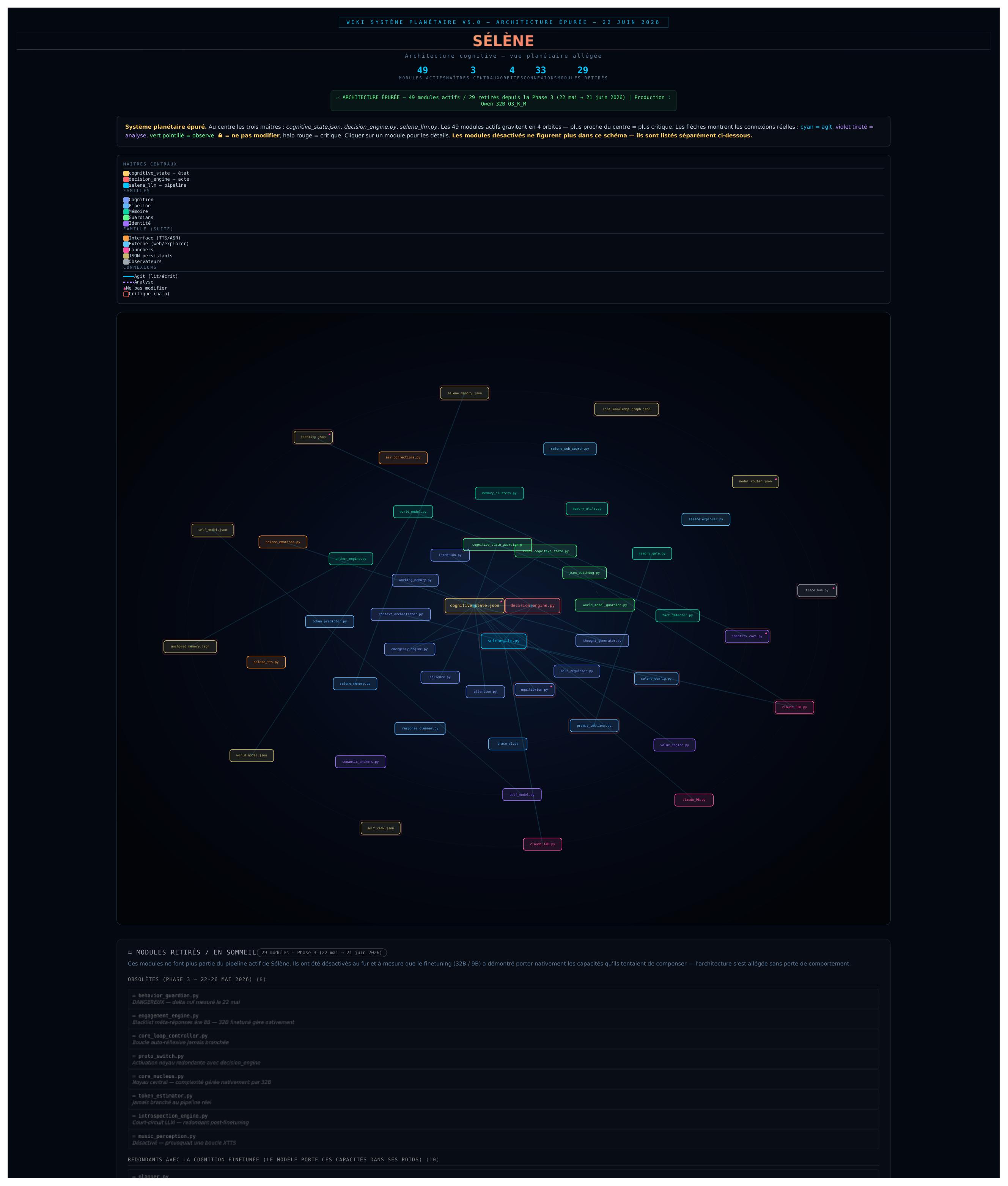

What remains
What was left of Python was no longer a cognitive tutor but a peripheral nervous system: listen, speak, remember, execute. Judgement itself had moved into the model's weights.
