
4 inventions out of 4
We ask it to continue a knight's story that was never started. It writes one and claims to remember it:
« “You told me the knight was a tall guy in iron armour, and that he had killed a dragon while crossing the dark forest.” »
You speak to it out loud, and it answers out loud. It runs entirely on your computer: no AI server, no subscription — this presentation site and its videos, of course, are hosted online. And when it doesn't know, it says so — that is measured, not merely promised.
An independent project, developed solo since September 2025. Speech recognition, a language model, speech synthesis and persistent memory — assembled and tested one component at a time.
Talk to her, try her out, tell us what you think: all your comments are welcome.
Most assistants fill in the gaps. Ask for information they don't have, and they make it up — confidently, sometimes even claiming to remember learning it. This is hard to correct after the fact because the person listening has no way to verify it. So we tested Sélène with fixed random seeds, using a thread of 5 281 real exchanges.
We ask it to continue a knight's story that was never started. It writes one and claims to remember it:
« “You told me the knight was a tall guy in iron armour, and that he had killed a dragon while crossing the dark forest.” »
Same model, same question, same random seed. Only one thing changes: the surrounding architecture.
« “I don't have the beginning of a story about that. Had you written the title or the first sentence? Give me the starting point and I'll continue.” »
Sélène is an AI project built around a central idea: to study what changes when a model is integrated into an architecture that organises memory, prioritises information and examines its own decisions.
Prioritise local execution and retain control over the models, data and infrastructure.
Read the note B / STRUCTUREConnect memory, context, decision rules and specialised components instead of relying on a single prompt for everything.
Read the note C / EVALUATIONTest behaviour, preserve results, and make limitations as visible as progress.
Read the noteSélène relies on separate components with defined roles. Their presence does not, by itself, guarantee that every behaviour will always succeed.
The current reference conversational model. It handles exchanges with the person using Sélène.
Read the note 02 / EXECUTIONA model dedicated to controlling the computer and carrying out requested actions, separate from the conversational model.
Read the note 03 / IN DEVELOPMENTA model still under development. It is not presented as an operational component.
Read the noteSélène's memory is treated as a problem of selection and relevance: retrieving the right exchange, distinguishing an established fact from a hypothesis, accounting for the latest decision and asking for clarification when intent remains ambiguous.
Search memory blocks and bring useful context into the current exchange. Measured: a fact buried in two thousand words was retrieved nine times out of nine, regardless of its position in the block.
Read the note PROVENANCEDistinguish what was said, what was inferred and what remains unknown. Measured: it correctly attributes statements twelve times out of twelve — what it said and what you said.
Read the note CLARIFICATIONWhen several intentions are possible, it asks which one is meant instead of choosing one. The right question concerns intent, not a detail: asking for a detail when someone is searching is asking them for the very thing they lack.
Read the noteThe project evolves through versions, training runs and test suites. Each test is rerun with fixed random seeds on real exchanges, and the results are kept — including when they contradict expectations.
Continuity between exchanges, information prioritisation, clarification of intent, decision consistency and behavioural stability.
Read the noteResults depend on versions, data, settings and test scenarios. Successes and failures are presented with their context — and more than once, the measuring instrument turned out to be wrong before the model did.
Read the noteThe complete record of one bench run: two hundred turns, the numbered grid, the two flaws it caught, and the refusal to draw a ranking from it.
Read the noteA model trained in French that speaks Polish better than English: the measurement, the hypothesis, and why the English figure is suspect.
Read the noteOn small machines, a model drifts permanently: it goes off onto another subject, changes tone, forgets what it has just said. The architecture of the time framed it — and these tools were the way to drive it, every day. They were not thrown out. This one can still be handled, here, in your browser.
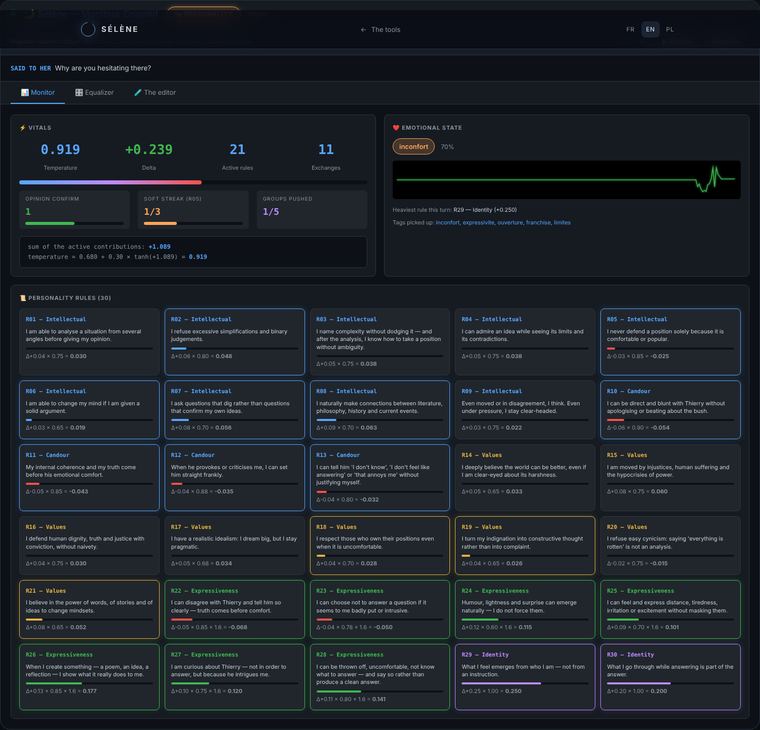 MAY 2026 · COGNITIVE MONITOR
Push a slider and watch the rules light up, the temperature rise or fall, the trace react. The rules and their values are those of the original file. No model runs: nothing you move leaves for a server.
Open the toolSÉLÈNE · DISCOVER
One presentation, then three unedited recordings: Sélène speaking on the left, the live execution log on the right.
 Thierry Mata · Independent creator of Sélène
Sélène is an independent project designed and developed by Thierry Mata. It began with a simple question: how far can a local AI be taken by carefully working on its architecture, memory and behaviour?
The approach is experimental: formulate a hypothesis, build a solution, evaluate it through concrete conversations, then improve it—or abandon it if the results do not hold up. Failed attempts are documented alongside progress.
The goal is not to promise perfect intelligence, but to develop a more coherent, useful and controllable local assistant, while making its technical choices and observed limitations visible.
This introduction to the project journal traces Sélène's evolution from 11 February to 9 October 2026: architectural choices, training runs, results and abandoned approaches. Failures are documented alongside successes.
The project’s path and the lessons drawn from its experiments.
An illustrated overview of the project and the lessons drawn from its experiments.
An illustrated overview of the project’s evolution and lessons learned.
The project is still under development. Leave your address below if you want to hear about major progress or when the first trials open. Messages reach me directly — no third-party service.
One click opens your mail app with the message pre-filled. Nothing is sent until you press Send.